



|
|
|
|
        |
 |
|||||
  At home in the Nenets cabin 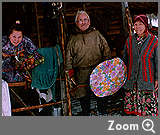 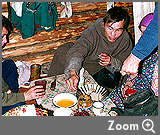 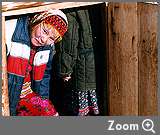 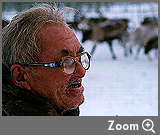 >Visit the tundra Nenets during their annual spring festival. |
 |
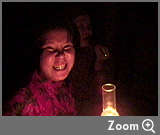
Day 2: Babushka's House Sasijohan, Siberia -- Shortly before dusk, after trudging 10 kilometers through swamp and forest with my three companions, I hear the sound of a new voice wafting through the forest. It's a woman standing near a small river. Valya Pyak, Ilya's 15-year-old sister, is wearing a colorful dress with embroidered sleeves. She takes over from Ilya and leads us the rest of the way into the darkening night to the home of their parents. After what seems like another eternity, there it is: a log cabin with soft light from a kerosene lantern shining through a lone window. "Here it is, we made it!" Valya exclaims as she pushes the small door open. I step through and enter a different world. A fire burns in a metal stove in one corner of the single large room. Reindeer pelts and blankets cover a sleeping section, while tea cups, saucers and a giant pot of wild blueberry jam sit on a squat little wooden table. A wooden baby's cradle hangs in a corner, not far from homemade deer bridles fastened to the wall. It feels like I've stepped into a 19th-century pioneer cabin in an open-air ethnographic museum. Please be welcome Yet this is no museum -- it's a sturdy log cabin hewn straight out of the forest by Valya's parents -- Veku and Tula Pyak. The commotion of our arrival rouses them out of what they thought would be a quiet night, and they lean up to peer at us from under a layer of reindeer pelts. "Bolshoy surpriz (Quite a surprise)," I sputter, trying to imagine how my own mother would feel if total strangers were to drop in for a few days' visit in such a manner. Tula, the woman we would come to call "Babushka" (affectionately "grandmother") only chuckles in response as she throws on a shawl and shuffles over to the stove where she sets an ancient, soot-covered water kettle. "Please be welcome," she says as Valya bends over double to wipe the floor with a rag, then sets the table in the center of the room. "Beiill, te ustal?" (Bill are you tired?) Valya teases me, cocking her head sideways to look up from her stooped position near the floor. "It's quite a long way out here," I say as we squat down cross-legged to drink tea, eat chunks of raw fish and slices of bread covered with blueberry jam. The man of the house, 67-year-old Veku or "Dedushka" (Grandpa) looks at me curiously through Coke-bottle thick glasses held together with masking tape. "Snow didn't help, I guess," he says, remarking on the early-season snowstorm that had been blowing through for several days. A man of few words, "Ded's" rough hands and seasoned face bear witness to the harsh life in the Arctic wilderness. Both he and Babushka seem far older than 60-something. People of the forest These people are known as "forest Nenets," to distinguish them from their ethnic cousins who live farther north on the open Siberian tundra (the "tundra Nenets"). Unlike those completely nomadic tundra dwellers, these Nenets live in forest cabins through the winter and have much smaller reindeer herds. Alyosha sets about explaining our presence: We have come to spend a few days to see what life is like here, deep in the northern Siberian forest. Both Ded and Babushka nod slowly in response. As Ded begins to talk, I notice three animal skulls staring out from a small shelf in the corner. One is a large bear's head wrapped in a colorful scarf with buttons in place of eyes, now glowing eerily in the soft light of the kerosene lantern. Next to the bear sits two smaller wolverine skulls. All have spiritual meaning, particularly the bear ... a sign of things to come. | |||
| |||||

