



|
|
|
|
        |
 | |||||
  Herding reindeer 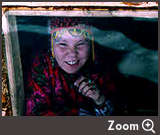 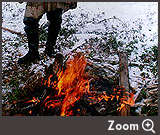 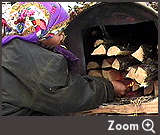 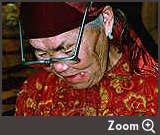 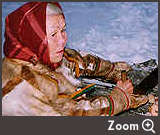 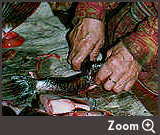 >Visit the tundra Nenets during their annual spring festival. |
 |
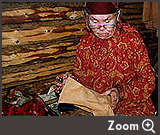
Day 3: Daily Life Sasijohan, Siberia -- I must admit to having slept badly last night. It wasn't the fault of the reindeer pelts, which have thick fur that provides great padding. It also wasn't the snoring from some of the others, or even the early morning chill that gradually overcame the cabin after the fire burned itself out during the night. The problem was the small log separating the sleeping area from the rest of this all-purpose room. My feet simply wouldn't fit inside and thus had to go on top of it. I couldn't very well lie diagonally as things were quite crowded with so many people all lying next to each other; privacy is certainly not to be had in a Nenets' cabin. So my feet had nowhere to go but atop that log, which even an extra deer pelt couldn't pad down. Just before dawn, Valya is up to light the lantern and stoke the stove to life. Though she quickly disappears again beneath her own little mountain of pelts, soon Babushka is up, putting on the morning tea. I manage a few "dobray ootras" (good mornings) to my cabin companions as I try to wash away a bit of yesterday's sweat over the enamel basin that serves as the sink. A small lever sends a thin stream of water tumbling down from a metal container suspended over the basin. This is the only way to wash here in the Siberian forest, save for the brief summer when one can swim in nearby ponds. I also trot out to the rundown outhouse, shuddering to think of what it's like to use it in the bitter cold of winter. Men tend the deer Soon we are squatting at the small table in the center of the room to sip tea again. "I've got to head out after the deer," Ded says quietly, smearing wild blueberry jam onto some bread. "It's been a few days." Unlike the tundra Nenets, whose deer herds are constantly on the move during their migrations, the forest Nenets must move their deer through the forest around their cabin and keep the animals from overgrazing their favorite food -- a mossy lichen. It's a coordinated activity. Men from the area (mostly relatives) move the animals every few days from the forest into a temporary corral and then let them head back out in a different direction to forage in another area. As Ded speaks, his youngest son Oleg walks in, brushing snow off of his reindeer parka. He lives in another cabin, just a stone's throw away from his parents. "Summer's a different story," Ded goes on without interruption. "Terrible year this was -- never saw so many 'komarov' (mosquitoes). That's why the deer aren't as fat as they should be." The insect breeding season is very short this far north, so mosquitoes (and other pests such as gnats and black flies) come out in force during the summer. The insects can be downright dangerous. They can literally suck a deer (or person, for that matter) dry if one isn't careful -- no joke. "The only remedy for the deer is to keep 'em in the smoke," Oleg continues, kneeling down on one knee as Babushka serves him a cup of tea. During the short summer, the men work in shifts to keep a fire going in the middle of a corral, placing green wood and moss on top to produce a smoky haze. The animals venture out only to eat quickly before returning to the relief the smoke provides. People escape in a similar manner, which explains the presence of the little smoke pots in the corner of every cabin. Why live in an area such as this, then? Ded and Oleg only smile. "This is our place, that's all." Women tend the home As both men pull on their swamp boots and head out, Babushka settles down to work on a new pair of "kee-see" -- winter reindeer-pelt leggings which run up the full length of the leg, almost to the hip. The furry boots sit on her lap as she works from a homemade sewing kit, using coarse thread made from strands of a deer's spine. For lighter work she uses other thread and needles tucked into a colorful, square pincushion. "This here, do you know what it is?" Babushka asks with a smile. She is holding up a small piece of fur which forms a little pocket, a natural thimble. "It's from his penis!" Valya exclaims gleefully, pointing to the wolverine skull staring out at us from the shelf. "Ah-hah, now you had me there," is all I can say, thinking that it certainly illustrates the tradition of making use of every part of an animal. "And these, they're from a swan," Babushka goes on, fingering three gray balls of fur which serve as pin cushions, sewn right onto the colorful sewing kit. "Bill, look here, too," Valya says, as she "cures" a large reindeer hide by scraping its backside with an oblong knife wedged into a wooden shaft. It looks like tough work -- she holds the big pelt on a board and scrapes downward. The thick reindeer hairs get onto absolutely everything, sticking to clothing, backpacks, you name it. But the hairs are, in effect, what renders life in such a rough climate possible. The tiny bit of air caught inside each hair provides the perfect insulation that enables the deer -- and, by extension, the humans who wear the pelts -- to withstand the bitter winter cold. The two women carry on with chores all morning. At one point Valya pulls on her parka and walks a short distance away to haul in some water from a nearby pond. The two women also go out to saw new firewood, mostly small, dead trees that the men have hauled in by sleigh from the surrounding forest. They are both amused as Alyosha and I pitch in to chop up some bigger logs with an ax. "Mama, look at Bill chopping!" Valya shouts, a bit to my embarrassment. By then Babushka is inside again, kneeling down to cut up what she calls a "sacred" fish (actually a northern pike). Why sacred? "You see this part of the bone? It's in the shape of a deer's hoof. And this (cartilage), it looks like a person. And this one's in the shape of the oar for a canoe." Oleg's wife, Anna, is busy nearby lighting the outdoor oven in which bread is baked. "Simple forest life," says Alyosha as we watch. | |||
| |||||

