



|
|
|
|
        |
 |
|||||
  Lassoing dinner  A reindeer feast 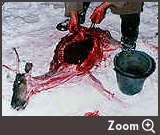 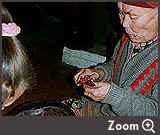 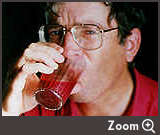 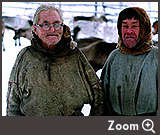 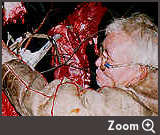 >Visit the tundra Nenets during their annual spring festival. |
 |
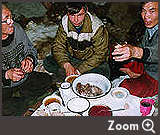
Day 4: A Taste for Reindeer Sasijohan, Siberia -- Valya smiles at me in the dim light of the kerosene lantern. Crack! Crack! She hits a blood-covered bone with a knife. Finally the bone breaks open and she nimbly scoops the yellow marrow out of the inside cavity. "Special for you, our honored guest," she laughs. It tastes like raw fat, only lighter, melting in my mouth. "Ummm, delicious," I feel obliged to say. Fresh blood comes next, courtesy of a family friend named Sasha, who butchered the small reindeer. The blood has a milk-like texture and tastes like liquid raw meat. Before I arrived in Siberia, it never occurred to me that fresh blood and bone marrow would be on the menu or in my mouth. But here we are. My odyssey begins at the Khanty neighbors' corral where, earlier today, that blood and bone marrow are still inside a living reindeer. Catching dinner It takes a coordinated effort by most of the men to herd the animal, along with 30 others, back from the forest to their corral made of rough-hewn logs near the Khanty cabin. Before we see the men gently prodding the deer through the forest, we hear a herding song wafting through the chill air: "yoh-yoh, yo-hoh-hoh." Soon, there is movement through the trees, and both deer and men gradually emerge and slowly move toward the corral. The man singing the song is Ded's Khanty counterpart, Nikita Kantirove, who is riding a sled into the corral while Ded, Oleg, Ilya and other men from this extended "neighborhood" -- the only two families living anywhere nearby -- follow on foot. While similar in most ways, the Khanty are less Asiatic in appearance and less outgoing than the Nenets. The two groups have always lived side by side and often intermarry. The two groups speak dramatically different languages (Khanty most closely resembles Hungarian) but are able to communicate, mostly speaking Russian. Here, they also share duties caring for the deer, though each man knows exactly which animals belong to whom. Acquiring a herd of reindeer can be a lifelong process, and as a man ages, he gradually passes deer along to his sons on special occasions such as birthdays or weddings. During the Communist era, everything officially belonged to a collective farm. Since the disintegration of the Soviet Union in 1991, many Siberian reindeer herders have gone back to their traditional ways, although in some areas the traditions have been all but destroyed. "Welcome," Nikita says to me as we watch the men lasso deer circling the corral. Sasha enjoys mugging for my camera as he lassoes a deer or two. Then he hands the lasso to me. "Sure you can do it -- like this," he says, demonstrating how to properly coil the reindeer-hide rope. Coiling the rest of the rope into two loops in each hand, you then thrust one of the loops at the head of the deer while the reserve plays out from the other coil. Lo and behold, on the first try, I manage to rein one in, to the cheers of the others. Granted, the animal wasn't moving very fast and was hardly far away, but still. It is Ded who asks the inevitable question. "You want to try one for dinner?" Brain and other delicacies And so here I am, drinking blood. Blood holds a special place in the traditional herders' diet because of the many vitamins and minerals it provides, particularly during the long winter months. The reindeer are killed by strangulation so that no blood is lost. Sasha serves the blood up out of a large bucket around which everyone in the family crowds. Ded, Babushka and Valya all hold hunks of meat in their hands and are stripping it off the carcass bit by bit. A Khanty neighbor named Efim works on the upturned skull to remove the brains -- another great delicacy. A small plate holds the animal's liver, kidneys, heart and lungs: all considered the best of the best, to be consumed raw immediately after the kill. Except for an occasional laugh from Valya, everyone is silent. I am feeling close to the core of this herding culture -- eating the choicest food they consume, right in their midst. Raw is the way they like it best, especially the meat closest to the bone, which they strip off with knives. Ded, Sasha and Efim have taken care to appease the gods for this blessing of food with elaborate rituals during each step in the process: killing, butchering and eating. After the deer is killed, the men stand before the carcass, bow three times, then turn around in circles several times to honor the spirits of the four directions. Then, after skinning the carcass, Sasha cuts open the body cavity, removes the organs and finally, uses a hunk of the rib cage to scoop out the blood. "We need to feed the spirits, too," he says, throwing a scoop full of blood onto the snow in all four directions before ladling the rest into the bucket. Ultimately, big hunks of meat hang from the branch of a nearby tree for tomorrow, the outside cold providing an ideal natural refrigerator. Both the deer's head and heart are placed at the front of the sacred sled, which carries a box containing small spirit figures. Later, the family will honor their new friends in a ceremony in the spirits' presence. | |||
| |||||

