



|
|
|
|
        |
 |
|||||
  A family ceremony 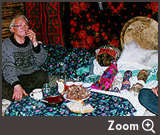 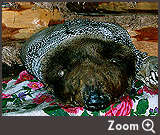  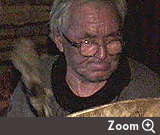 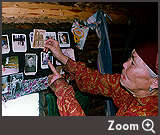 >Visit the tundra Nenets during their annual spring festival. |
 |
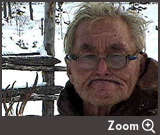
Day 5: Thanking the Spirits Sasijohan, Siberia -- Ded sits in the corner of the sleeping area beating ever faster on the large shaman drum: "whoom-woom-woom-woom, whoom-woom-woom-woom." He gets onto his feet and turns around in praying circles, continuing the rhythmic beating. He begins a slow chant, alternating between his native Nenets language and Russian -- for our benefit. "We ask for your blessing in honoring our guests, to help them in their tasks as well as protect them when they leave to go home," Ded prays. Much of this ceremony has been resurrected from a past these people are only now reclaiming: The practice of shamanism was harshly repressed during the long decades of Soviet rule, even in these remote parts. This is a family ceremony, which really only involves the trappings of shamanism -- Ded claims he's not "spiritually strong enough" to be an actual shaman. He is old enough, however, to recall real shamans who conducted ceremonies in the 1930s, before the boot of Soviet repression came down. Family spirits The ceremony begins as vodka toasts are poured out of a bottle we brought as a gift. Before we raise our glasses, Babushka pours the first shot over the stove, resulting in a brief roar of flame, to honor a key spirit -- that of the fire. Ded is sitting in front of four small figurines that serve as the family spirits. Wrapped in colorful bits of cloth or reindeer fur, each one represents a different spirit. A tall one with golden buttons for eyes is the spirit of the forest. Another honors the spirit of a neighboring region where the family's forebears came from. Still another stands for Numto, the lake near the settlement where we'd first arrived, a large body of water that is sacred to many northern peoples. The fourth is "Menk," a mythical yeti-like figure who is featured prominently in stories, and who may well embody the unforeseen dangers that lurk in the wild. But the place of real honor is occupied by the stuffed bear's head, still wrapped in its special cloak and brought down from the shelf for the occasion. It is one of the first bears Ded ever bagged and, by tradition, holds the highest place of honor in the cabin, where it wards off evil spirits. Similar bear heads sit in every cabin in the region, each having been consecrated in elaborate ceremonies that often take place over several days. This powerful beast of the forest exists entirely in the male domain, and women are not allowed to touch the bear head, even while cleaning. "All of this has deep significance for peoples throughout the north," Alyosha explains later. "We were lucky to witness this ceremony in such a manner, as not all people want to share their own, personal spiritual beliefs with outsiders -- certainly not to see their spirit dolls." Earlier, Ded had taken a long time preparing for the ceremony by carefully unwrapping each spirit figure, which are all kept on a special sled out back and accompany the family on long trips. Family history After the ceremony, the spirits seem to inhabit the little cabin, and everyone opens up as we settle down to chat around the ever-present kerosene lantern. Alyosha and Marina use the occasion to quietly record recollections for their ethnographic work, as I struggle to understand the conversation through the heavy accents in which the Nenets speak Russian. Ded and Babushka reveal some difficult family history: They lost their youngest son, Ivan, just a few months ago. He died of exposure one night after imbibing too much vodka and passing out in the cold. He had long been the black sheep of the family, and had even spent some time in prison. His death means that Oleg has now assumed the mantle of youngest son, which is why he lives closest to his parents -- in order to care for them as they age. (In return, he also receives proportionally more reindeer as Ded slowly relinquishes his herd over time.) At one point, Valya asks me, "Beeill, why don't you stay here, live with us!" She repeats this several times each day until we leave -- something I laugh off as playful joking. Not so, I later learn. "She's only 15, but already been married twice," Marina explains. "She has a kind of nervous condition, which may be why the men left both times. Then imagine, suddenly you and Alyosha appear into her life, even if for just a few days. She's emotionally desperate, and really meant it." I try to imagine what it would be like to give up my 20th-century life and move into the forest -- to follow this life. Much as I admire and respect the Nenets, it would be impossible. Later we bring in hunks of meat for another deer meal, though thankfully, some of it is now boiled. After we finish the meal, Ded turns and hands me a pair of bear's teeth he keeps with the spirit figures. "These are for you to take, to help guide your way," he says quietly. "Only take care at home to put them somewhere where your wife and daughter can't touch them. That's our way." | |||
| |||||

