



|
|
|
|
        |
 |
|||||
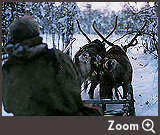  Dashing through the snow on a home-built sled 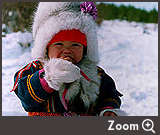 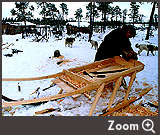 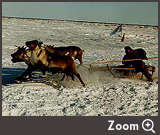  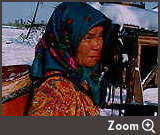  >Visit the tundra Nenets during their annual spring festival. |
 |
Day 7: Deconstructing Santa Claus Sasijohan, Siberia -- As we gather on the reindeer pelts after our final meal of boiled deer meat, raw fish, bread and jam, I broach the Santa question. It's easy to see the roots of the Santa Claus legend in the traditions of the native peoples of the North. The colorful Samis (formerly Lapps) are certainly the spittin' image of Santa's "elves" in western cultures. These Scandinavian reindeer herders wear red suits with shirts that jut out a little around the hip. Their long felt hats do indeed flop over to one side, some with a cotton ball sewn to the tip. Their reindeer-pelt shoes curl up at the toe and jut backward. (In the past, this helped them slip into their skis.) And during ceremonies, the Nenets often lace bells around the necks of their reindeer. Combined with a light clicking sound made by tendons in the deers' legs when they walk, these bells make for a truly magical sound as the animals prance through the snow. "Many foreigners associate reindeer with Santa Claus," I say. "Do you have any tradition similar to this 'jolly old man' who lives in the north and brings presents to children with the help of a reindeer and sled?" Babushka looks puzzled as Alyosha helps explain the question. The answer: She can't see why anyone associated with the north in December -- the dead of winter -- would be jolly. Winter in Siberia is not a time to celebrate "We have a 'man of the north,' but he's the one who brings us the short days and bitter cold," Babushka says, her eyes looking intent in the soft lantern light. "He's really an evil spirit, you know, the one we scorn for bringing the harsh season upon us." Alyosha draws on his vast experience in the region to put things further into context. "Traditionally the biggest celebrations for northern Siberian peoples come in the spring, when the days grow longer and it warms up again after the long winter," he says. "Think about it. What do these people have to be happy about at the end of December? There's almost no daylight, they're forced to spend much of their time in the cabins (or teepee-like 'chooms' in the case of the tundra Nenets). They basically can't wait for the long winter to be over." Most northern peoples have adopted the Russian tradition of celebrating the New Year, although even Russians de-emphasize Christmas (partly a legacy of Soviet times). Easter is by far the most important day in the Orthodox church calendar. In Russia's case, the eggs of Easter symbolize rebirth -- not just for the resurrection but also for the release from winter's icy grip. A family economy As the conversation continues, I also ask about broader political issues. After all, this is Russia, though it hardly feels like it. What do they think about Boris Yeltsin and Russia's perennial economic crisis? Ded looks quizzical and laughs. "It may be a crisis out there, but I don't really have much to say about it," he says. Had he voted in the last elections? Sure. But what difference does the outcome really make to him? Out here, none of the hand-wringing in the big cities seems to have any impact. The Nenets are virtually self-sufficient; my new friends provide almost everything for themselves and have no need for institutions such as banks. In fact, Ded and Babushka's small monthly pension payment, brought in on the helicopter flights to Numto, is the outside world's only real contribution to their life. The family economy is broader than just reindeer. Another son lives about a half-day's walk away and runs a small fishery. Using a traditional series of traps made from branches that stretch across a river, he provides hearty fish to the others, and they look after his share of the reindeer. The family also makes money selling berries to the helicopter pilots (as Ilya did the day we arrived) as well as selling an occasional deer to the Khanty who live in a nearby region that has been spoiled by gas and oil development. The families here have been spared this plight because in early 1997 the area around Numto Lake was declared a national park. On paper at least, the park protects the natural environment as well as the native peoples living within its boundaries. There has been talk, however, of some oil drilling just inside the park boundary. The Russians The Nenets first felt the impact of the Russians in the 1930s. A rebellion broke out after Soviet officials took some of the Nenets' children away. Due to the language barrier, the native people didn't understand what was happening. This was the beginning of collectivization, when native peoples were forcibly integrated into the Soviet farm system. The children were taken to be the first pupils in a boarding school in a town called Kazym. Today, Nenets children still attend this school, but in 1933, the misunderstanding led to some native men sneaking into the town and killing the teachers. Ultimately, the Red Army was sent in to squash the rebellion, and resistance to collectivization ended. Over time, children continued to go to school, and today the people are glad they are educated and able to maintain their traditions at the same time. Children are required to stay in school until the eighth grade, when most return to their traditional homes. After all of the attempts to stamp out their culture, it is amazing how resilient it is. During collectivization people became more dependent on a money economy, earning official "salaries" through the state farm system. That system all but collapsed in 1991, leaving everyone to fend for themselves once again -- readapting to a life that does have some negative consequences. "Before, if someone got sick, we could radio in and a helicopter would come right out," Ded says. "Now it might not come at all." Recently, Ilya's 4-year-old daughter seriously injured her arm when she grabbed onto a deer. It took four days to get her to the hospital, where an operation was required. "Fortunately she's all right now," Babushka says. As with many people across Russia, I sense certain nostalgia for some of the guarantees that the old system provided. There is a certain economic uncertainty associated with the new way, despite the herders' isolation and virtual self-sufficiency, or perhaps because of it. Yet on the whole, my new friends still seem content with their ability to once again do things according to tradition. | |||
| |||||

